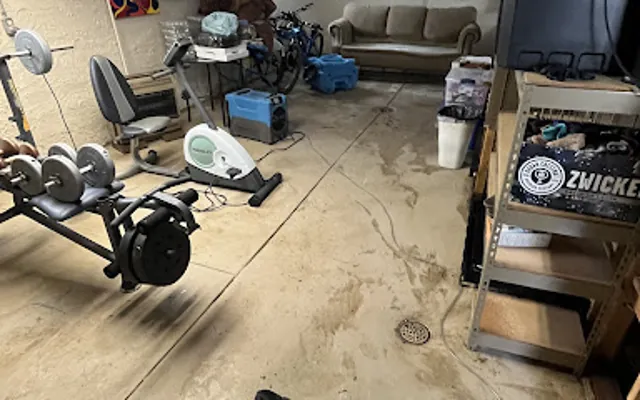
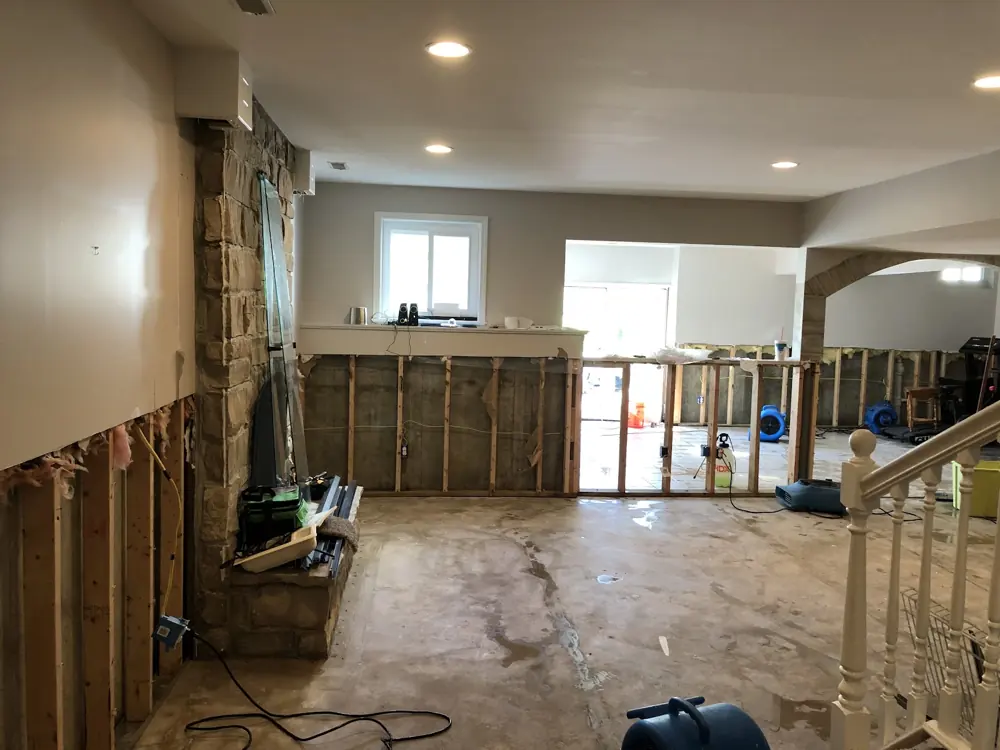
A pipe leaking under a concrete slab can run for weeks before a warm spot on the floor or a climbing water bill gives it away. In San Mateo's many slab-on-grade ranch homes, a crew is typically on site within about an hour to trace and dry it out.

A crew typically arrives within about an hour to confirm active water intrusion and coordinate with a plumber on locating the leak in the slab.
Thermal imaging and moisture meters trace how far water has spread under flooring, marking the affected zone before anything is opened up.
Affected flooring and baseboard are removed only where readings confirm saturation, to expose the slab for both drying and the plumber's repair access.
Air movers and dehumidifiers dry the slab and surrounding framing to a verified target, with every reading logged for the insurance claim.

While help is on the way, these first steps, done only where it is safe, limit the damage and protect the insurance claim.
Shut the supply off at the source, or close the home's main valve if the source is not obvious. Stopping the flow limits the damage more than anything else.
Switch off electricity to the affected area, but only if the breaker can be reached without standing in or touching the water.
Get a crew dispatched right away. The sooner extraction and drying begin, the more flooring, drywall, and belongings can be saved.
Take photos and a short video of the water and the affected rooms before anything is moved, so the insurance claim starts strong.
Slab leak water damage restoration in San Mateo typically runs from about $1,500 to $6,000 for the drying and flooring removal portion, separate from the plumber's cost to actually repair or reroute the leaking line. A leak caught early with limited flooring affected sits on the lower end, while a leak that ran for weeks under carpet or hardwood across multiple rooms runs higher. Sudden slab leaks are commonly covered for the resulting water damage under a standard homeowner policy, even when the plumbing repair itself is handled separately, and documentation supports both.
Crews reach San Mateo and San Mateo County fast, from North Central, Hayward Park, and Aragon to Shoreview, Sunnybrae, and Hillsdale, plus nearby Foster City, Burlingame, and Belmont. See the full list on the areas served across San Mateo page.
See all areas servedEvery loss is photographed, measured, and logged from the first visit, so the paperwork holds up with the insurance carrier.
Technicians follow recognized IICRC drying standards and prove it with daily moisture readings on San Mateo homes, not guesswork.
Emergency dispatch any hour of the day or night, with a real crew on the way across the mid-Peninsula, not a callback in the morning.
A real crew dispatched any hour, not a callback in the morning.
Trained technicians following recognized IICRC drying standards.
Truck-mounted, portable, and submersible for any size loss.
The loss is documented and billed to the carrier directly.
Warm or damp spots on flooring with no visible source, a running water meter when everything is off, and a climbing water bill are the usual signs. A plumber confirms the exact leak location, and the crew maps the water spread.
No. A plumber locates and repairs or reroutes the leaking line. The crew focuses on moisture mapping, extraction, and drying the flooring and structure the leak affected.
Only what moisture readings show is actually saturated. Flooring outside the mapped wet zone is typically left in place rather than removed as a precaution.
The sudden water damage from a slab leak, meaning the flooring and drying work, is commonly covered under a standard homeowner policy. The plumbing repair itself is usually treated as a separate, often uncovered, maintenance cost.
It can, especially under carpet or engineered wood. Once the area is exposed, it is checked and treated as part of the drying plan rather than sealed back up before verified dry.
San Mateo crews are on call 24 hours a day, local and fast, and can be on the way within the hour.
Call (650) 281-0978