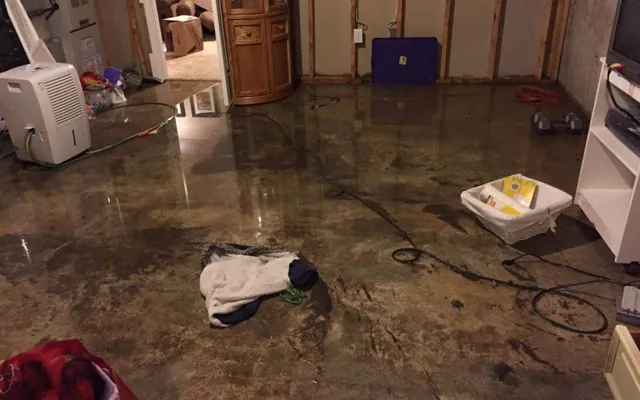
Water heaters in San Mateo are often tucked into a garage, closet, or crawlspace where a failing tank can leak for days before anyone notices. A crew responds fast to extract the water and dry whatever it reached.

A crew arrives in about an hour and confirms the water supply to the tank has been shut off before extraction begins.
Standing water is extracted from the garage, closet, or crawlspace floor, with attention to how far it traveled toward adjoining rooms.
Any stored belongings, flooring, or drywall near the tank are checked for water damage, and saturated material is removed where it cannot be dried in place.
Dehumidifiers and air movers dry the area while the tank replacement is scheduled, since a failed unit is not repaired, only removed.

While help is on the way, these first steps, done only where it is safe, limit the damage and protect the insurance claim.
Shut the supply off at the source, or close the home's main valve if the source is not obvious. Stopping the flow limits the damage more than anything else.
Switch off electricity to the affected area, but only if the breaker can be reached without standing in or touching the water.
Get a crew dispatched right away. The sooner extraction and drying begin, the more flooring, drywall, and belongings can be saved.
Take photos and a short video of the water and the affected rooms before anything is moved, so the insurance claim starts strong.
Water heater leak cleanup in San Mateo typically runs from about $500 to $2,800, separate from the cost of the replacement tank itself, depending on how long the leak ran and how far it spread. A leak caught within a day in a garage with a floor drain sits on the low end. A slow leak in a closet or crawlspace that ran for days and reached flooring or drywall in an adjoining room sits on the high end. Sudden tank failures are commonly covered by homeowners insurance for the resulting water damage, though the tank replacement itself is usually a separate expense.
Crews reach San Mateo and San Mateo County fast, from North Central, Hayward Park, and Aragon to Shoreview, Sunnybrae, and Hillsdale, plus nearby Foster City, Burlingame, and Belmont. See the full list on the areas served across San Mateo page.
See all areas servedEvery loss is photographed, measured, and logged from the first visit, so the paperwork holds up with the insurance carrier.
Technicians follow recognized IICRC drying standards and prove it with daily moisture readings on San Mateo homes, not guesswork.
Emergency dispatch any hour of the day or night, with a real crew on the way across the mid-Peninsula, not a callback in the morning.
A real crew dispatched any hour, not a callback in the morning.
Trained technicians following recognized IICRC drying standards.
Truck-mounted, portable, and submersible for any size loss.
The loss is documented and billed to the carrier directly.
Most tank water heaters last roughly eight to twelve years before corrosion leads to a leak. A unit well past that age is worth watching closely for rust, moisture, or a slow drip near the base.
Water heaters are typically installed in a garage, closet, or crawlspace rather than a visible living space, so a slow leak can run for days before it reaches somewhere noticeable, like a garage floor or a stain on a ceiling below.
No. A leaking tank has typically failed internally and is replaced rather than repaired. The cleanup addresses the water damage while the replacement is scheduled separately.
It depends on the material and how long they sat in water. Cardboard boxes and porous items are usually a loss, while plastic bins and elevated shelving often survive if the leak is caught reasonably quickly.
The resulting water damage from a sudden tank failure is commonly covered by homeowners insurance. The replacement water heater itself is typically a separate, non-covered expense unless the policy states otherwise.
San Mateo crews are on call 24 hours a day, local and fast, and can be on the way within the hour.
Call (650) 281-0978